
Tuesday, January 5, 2010

A Tip from the Dietitian....

Getting Started
Any time is a good time to start making healthy changes in your life. The beginning of a new year is a likely time to do some self-assessment and set some goals. Nutrition goals are often included. Whether your goal is to lose weight, lower your cholesterol level, eat more vegetables or any other nutrition related goal...Record Keeping can help. Research shows that record keeping is one of the most powerful tools we can use for helping to make change. If you'd like to use record keeping to help you in meeting your nutrition goal, keep these things in mind:
- Food records are more accurate and realistic if you record your intake as close to the time of consumption as possible. (It's more difficult to remember how many chips you ate at lunch by the time 10 p.m. rolls around.)
- Keep track of all that you eat or drink as it pertains to your goal. For example, if you are tracking Calories, the "samples" of food as you cleaned up the kitchen and put away leftover food can make a difference. If your goal is to increase your intake of vegetables or calcium, track all vegetables eaten or major sources of calcium in your diet.
- Be sure to note the day of the week, the day and the time of consumption. For instance, Monday, January 4, 2010, 9:00 a.m.
- Write down other details to your day as well, especially if you feel that you are straying from your goal. Knowing the details can help you figure out what was going on that kept you from meeting your goal.
- Know the facts! The Internet is a rich source of information on food. However, be sure to use credible sources. Food labels are also helpful. Read them carefully and be certain of what the label is referring to as a "serving size."
- Records can be kept in a small spiral notebook, on-line or by using a Smart Phone Application.
- Evaluate your records as you go through your day to help keep you focused on your goals.
- Review your records daily and summarize the day in terms of meeting or not meeting your goals. Be sure to acknowledge success. "Troubleshoot" for yourself if goals are not met. Think about how to work towards success for the next day. What might you do differently? Should you choose a different restaurant, order a different menu item, or eat more regularly throughout the day so as to not be overwhelmed with hunger when making decisions about food?
- Evaluate your records again on a weekly basis to help clarify how the week went.
- Ask for advice, help or support if needed from a healthcare professional.
Have a Healthy New Year!
Saturday, December 12, 2009
A Tip from the Dietitian....

HOLIDAY EATING
This is the time of year when most people are busy with all the things that make the holidays special. It’s also the time of year when, for many of us, our goals to eat healthy seem all but forgotten until the New Year comes around. You are likely to be familiar with the standard healthy holiday eating tips. Perhaps these additional tips can also help this holiday season.
1. Review your past holidays and identify behavior with your food and beverages you’d most like to improve on. Think through a new way to deal with these “problem” areas.
2. Eat regular meals, even on those special days… when you arrive at a meal hungry you are much more likely to eat too much.
3. Focus on the things you “can do” rather than what you “shouldn’t do”…work to find ways to include plenty of healthy fruits and especially nutrient- rich vegetable servings each day.
4. Drink plenty of water to help stay hydrated and eliminate the possibility of “confusing” thirst with hunger.
5. Work to include daily exercise even if all you can work in is a brief 10-15 minutes. You will feel better, and have an opportunity to re-focus on your nutrition goals for the day.
Happy Holidays!!
Tuesday, December 8, 2009
Recipe: Golden Raisin, Apple and Cinnamon Granola

Granola is a cereal-like combination of dried fruits, grains and nuts. Though it's a good source of protein and fiber, granola can also be high in fat and calories, especially the store-bought varieties. Watch your portion sizes or create your own granola to limit the amount of fat, calories and sugar in each serving.
Ingredients:
1/4 cup slivered almonds
2 cups dry, old-fashioned oatmeal
2 cups bran flakes
3/4 cup dried apple pieces
1/2 cup golden raisins
1 tablespoon ground cinnamon
1/4 cup honey or Agave Nectar
1/4 cup unsweetened applesauce
1 tablespoon vanilla extract
Directions:
1. Preheat oven to 325 F. Lightly coat a baking sheet with cooking spray.
2. Spread the almonds on the baking sheet and bake, stirring occasionally, until golden and fragrant, about 10 minutes.
3. In a small bowl, whisk together the honey, applesauce, vanilla, and cinnamon. Set aside.
4. In a large bowl, add the oatmeal and bran flakes. Stir to mix well. Add the honey mixture and toss with your hands. Don't break the clumps apart.
5. Spread the cereal mixture evenly onto a baking sheet. Place in the oven and stirring occasionally, bake until golden brown, about 30 minutes. Remove from the oven and cool slightly.
6. In a large bowl, combine the cereal mixture, toasted almonds, apple pieces and raisins. Cool completely. Store in an airtight container.
Nutritional Analysis: Per 1/2 cup serving
Kcal: 163
Carbs: 33g
Total Fat: 2g
Saturated Fat: 0
Monounsaturated Fat: 2g
Cholesterol: 0
Fiber: 4g
Calcium: 27mg
Sodium: 115mg
Potassium: 216mg
Monday, December 7, 2009
Exercise of the Week - Lat Pulldown
The Lat Pulldown is a great exercise and strength training move for the upper back and biceps. Although the biceps are secondary, they are still involved because any time you FLEX the elbow, the biceps contract. So, the muscles involved in Lat Pulldown are the Latissimus Dorsi (imagine that??), Rhomboids, Posterior (Rear) Deltoids, and Biceps.
There have been several questions raised as to where you should "pulldown." Behind the head or not? I will tell you there is a greater risk of injury involved in a behind the neck Lat Pulldown. Why is this? Well, here my little biomechanical rant...
The NECK is excessively flexed which places great stress on the cervical spine and disks. The shoulders are stressed because they are placed in an extreme external rotation and a hyper-extended position (i.e. the shoulder-elbow alignment is behind the mid-line of the body). This stress could contribute to injuries such as shoulder impingement, rotator cuff problems, and anterior shoulder instability. The Lat is also NOT optimally challenged because the line of pull does not adequately oppose the muscle fibers of the Lats.
Okay, that said, here is the correct approach to a Lat Pulldown:
1. Place the feet firmly on the floor and hands on the bar, a little wider than the elbows, in an overhang grip.

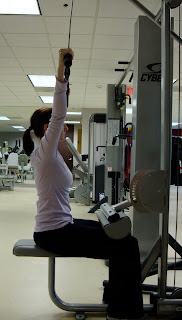
2. Pull the bar downward slightly, maintaining neutral posture and leaning back at the hips about 20 to 30 degrees (without rounding the back).


There have been several questions raised as to where you should "pulldown." Behind the head or not? I will tell you there is a greater risk of injury involved in a behind the neck Lat Pulldown. Why is this? Well, here my little biomechanical rant...
The NECK is excessively flexed which places great stress on the cervical spine and disks. The shoulders are stressed because they are placed in an extreme external rotation and a hyper-extended position (i.e. the shoulder-elbow alignment is behind the mid-line of the body). This stress could contribute to injuries such as shoulder impingement, rotator cuff problems, and anterior shoulder instability. The Lat is also NOT optimally challenged because the line of pull does not adequately oppose the muscle fibers of the Lats.
Okay, that said, here is the correct approach to a Lat Pulldown:
1. Place the feet firmly on the floor and hands on the bar, a little wider than the elbows, in an overhang grip.


2. Pull the bar downward slightly, maintaining neutral posture and leaning back at the hips about 20 to 30 degrees (without rounding the back).


3. Retract and depress the scapula (shoulder blades) and hold throughout the exercise.

4. Contract the abs and begin movement by contracting the Lats, driving the elbows down toward the floor and back slightly.
5. Pull the bar toward the upper chest while keeping the trunk from moving back and forth.
6. Return to the starting position.
And as always....DON'T forget to breathe!!
Till next time....Christie
Saturday, December 5, 2009
Yoga Pose....Downward Facing Dog
Adho Mukha Svanasana
(AH-doh MOO-kah shvah-NAHS-anna)
adho = downward
mukha = face
svana = dog

1. Come onto the floor on your hands and knees. Set your knees directly below your hips and your hands slightly forward of your shoulders. Spread your palms, index fingers parallel or slightly turned out, and turn your toes under.
2. Exhale and lift your knees away from the floor. At first keep the knees slightly bent and the heels lifted away from the floor. Lengthen your tailbone away from the back of your pelvis and press it lightly toward the pubis. Against this resistance, lift the sitting bones toward the ceiling, and from your inner ankles draw the inner legs up into the groins.
3. Then with an exhalation, push your top thighs back and stretch your heels onto or down toward the floor. Straighten your knees but be sure not to lock them. Firm the outer thighs and roll the upper thighs inward slightly. Narrow the front of the pelvis.
4. Firm the outer arms and press the bases of the index fingers actively into the floor. From these two points lift along your inner arms from the wrists to the tops of the shoulders. Firm your shoulder blades against your back, then widen them and draw them toward the tailbone. Keep the head between the upper arms; don't let it hang.
5. Adho Mukha Svanasana ison of the poses in the traditional Sun Salutation sequence. It's also an excellent yoga asana all on its own. Stay in this pose anywhere from 1 to 3 minutes. Then bend your knees to the floor with an exhilation and rest in Child's Pose.
Tuesday, November 17, 2009
A Tip from the Dietitian....

Calcium is essential to the development and maintenance of healthy bones. Many people, especially women and teenagers are not meeting their daily need for calcium. Take steps now to prevent Osteoporosis. Use these tips to make sure you get enough calcium.
* Know how much you need:
Teenagers: 1,300 mg/day
Adults (age 19-50): 1,000 mg/day
Adults (age 50+): 1,200 mg/day
* Become familiar with good calcium sources:
8 oz. milk: ~300 mg
8 oz. yogurt: ~400-450 mg
1 oz. low-fat cheese: ~200 mg
1 cup low-fat cottage cheese: ~155 mg
1 cup spinach or collard greens: ~300-350 mg
3 oz. salmon (bone-in): ~325 mg
1 cup soybeans (edamame): ~260 mg
* Add milk or yogurt to recipes whenever possible:
Make oatmeal and hot chocolate with milk instead of water
Make fruit smoothies from frozen fruit blended with yogurt and/or milk
* Look for calcium-fortified orange juice and other foods as well (especially if milk or yogurt are limited in your daily intake)
It takes more than an adequate intake of calcium to build strong bones. Regular weight-bearing activities are important too.
Subscribe to:
Comments (Atom)